
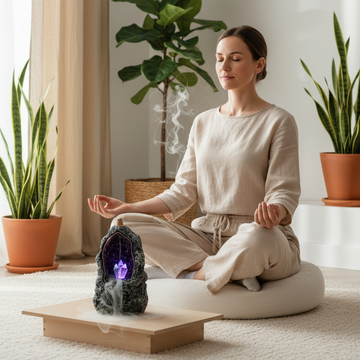

A lot of people start meditating at home the same way: they sit on the floor, try to “be still,” and then spend the entire session negotiating with their ankles, knees, and tailbone.
If that’s you, I want you to hear this clearly: discomfort doesn’t make meditation more authentic. It just makes it harder to stay with it.
Quick answer: you need two kinds of support—padding for pressure points and lift for your hips. Most people only add padding (a soft pillow), but don’t add lift. That’s why the body still complains.
Here’s the simplest way to fix your hard-floor meditation setup so you can actually focus.
-
Solve pressure points first
Hard floors create sharp feedback in the body: tailbone, outer ankles, knee caps, and sometimes the tops of the feet if you kneel.
Use small support in the places that hurt, not everywhere:
-
A folded towel under the ankles if cross-legged feels sharp
-
A thin blanket under the knees if they feel sensitive
-
A firmer seat under the hips so you’re not collapsing into the floor
This isn’t “extra.” It’s basic comfort engineering.
-
Don’t sit low just because it feels stable
A common pattern: people sit low because it feels grounded, but then their hips lock and their back rounds. The floor wins. Your mind follows your body and gets restless.
When the hips are slightly elevated, your spine can stack and your breath feels easier. Most people feel more stable, not less—because they’re not fighting their anatomy.
-
Pick a posture that matches the floor
If you’re on a hard floor, these tend to work best:
-
Burmese style (one shin in front of the other): less knee compression
-
Loose cross-legged: avoid pulling heels too close
-
Seiza (kneeling) with proper padding: great for some bodies, painful for others without support
-
Chair meditation: still counts, and sometimes it’s the smartest move
The goal is not a “perfect yoga-looking posture.” The goal is a posture you can repeat.
-
Use a cushion that doesn’t collapse
Soft couch pillows feel comfortable for 30 seconds. Then they compress, your pelvis rolls back, and your lower back does extra work. That’s when the “hard floor” feeling creeps right back in.
If you prefer a cushion with supportive structure (not overly squishy), a resilient, ergonomic seat can make hard-floor meditation feel dramatically easier because it keeps your hips lifted consistently.
If you want one option designed for supportive lift and a steady seat, you can look at ZenSoulLab’s Unity meditation cushion here:
https://zensoullab.com/products/zensoullab-unity-meditation-cushion-with-3d-resilient-support
-
Try the 10-minute comfort check
Before you commit to a “long meditation,” do a 10-minute check with your setup:
-
Minute 1: do you feel sharp pressure anywhere
-
Minute 3: do you feel yourself bracing
-
Minute 6: are you subtly leaning or rounding
-
Minute 9: do you feel calm enough to stay, or are you counting down
If you can get through 10 minutes without your body shouting, you’ve built a setup you can scale.
-
Make it easy to start (the real secret)
The best meditation setup is the one you don’t have to assemble every time. If your cushion is always nearby, if your blanket is folded and ready, you remove friction. You sit more often. That’s the whole game.
For more meditation learning and simple at-home routines, you can explore https://zensoullab.com/ anytime.
FAQ
Q1: Why does meditating on the floor hurt so much
A: Hard floors increase pressure on joints and bony areas, and sitting too low can lock hips and round the lower back.
Q2: Is a soft pillow enough
A: Often no. Soft pillows compress and remove hip lift, which can make posture worse over time. Supportive lift matters.
Q3: Where should I add padding
A: Add small padding where you feel sharp pressure—often under ankles or knees—while keeping the seat supportive and stable.
Q4: What’s the best position for floor meditation
A: Many people find Burmese style or a loose cross-legged seat more comfortable than a tight cross-legged posture on hard floors.
Q5: Can I meditate in a chair instead of the floor
A: Yes. Chair meditation is a legitimate practice and can be the most comfortable option for sensitive knees or hips.