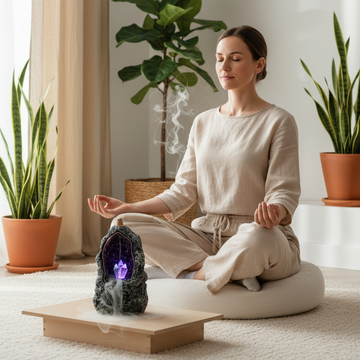

If you’ve ever sat down to meditate and felt your knees creeping upward, your hips tightening, or your lower back getting cranky within minutes, there’s a good chance your cushion height is simply wrong for your body.
Quick answer you can use today: your hips should be slightly higher than your knees—not dramatically, just enough that your pelvis can tip forward a little and your spine can stack without effort. When the seat is too low, your hips roll back, your lower back rounds, and your knees take the pressure. When it’s too high (for some bodies), you can feel unstable or slide forward.
Here’s how to dial in the right height without overthinking it.
-
Use the “hips above knees” test
Sit down in your usual meditation position (simple cross-legged is fine). Look at your knees. If your knees are higher than your hip crease, you’re likely sitting too low. Your body will try to compensate by rounding the back, tightening the hip flexors, and squeezing the legs—hello numbness and knee strain.
If your hips are slightly higher than your knees, your thighs can soften and angle downward. This is the position that tends to feel grounded and sustainable.
-
Notice what your lower back is doing
A common misconception is “I just need to sit up straighter.” But if the pelvis is tucked under, sitting up becomes work. Your back muscles will fight the posture the entire time.
When the height is right, you’ll feel this subtle shift: your sit bones become clear, your chest feels naturally open, and your head stacks more easily. You’re not “holding yourself up.” You’re resting in alignment.
-
Match height to your flexibility today, not your ideal self
Some days you’re tighter (travel, cold weather, too much sitting). Some days you’re looser. If you pick a height based on your best day, you’ll dread practice on a normal day.
A good rule: choose a height that lets you sit comfortably even on a stiff day. Meditation consistency beats “perfect form.”
-
Choose height based on your main issue
If your issue is knee pain: you usually need more hip height so the knees can drop.
If your issue is low-back rounding: you usually need more height or a firmer seat that doesn’t collapse.
If your issue is feeling unstable: you may need a wider, more supportive base (not necessarily lower), so you’re not balancing on a soft mound. -
A simple way to find your “sweet spot” in 3 tries
Try three seat heights in one week (or even in one afternoon):
-
Low (what you use now)
-
Medium (add a folded blanket or choose a cushion with moderate lift)
-
Slightly higher than medium
Each time, sit for 8–10 minutes and only track two things:
-
Do your knees soften or fight you
-
Does your back feel supported or strained
The best height is the one where you forget about your body sooner.
-
Why buckwheat can feel different (and why that matters for height)
Buckwheat hull filling tends to hold shape and stay supportive. That’s useful because a cushion that compresses too much effectively becomes “lower” over time—so your posture collapses mid-session even if it felt okay at the start.
If you want a stable seat that keeps its lift and helps keep hips gently elevated, ZenSoulLab’s T-shaped ergonomic cushion (buckwheat hull filling) is designed specifically for that kind of grounded support:
https://zensoullab.com/products/zensoullab-t-shaped-ergonomic-meditation-cushion-with-buckwheat-hull-filling
One more thing: you don’t need a “perfect cushion.” You need a setup that makes you want to sit again tomorrow.
If you want more simple meditation guidance that feels human (not preachy), you can explore resources and product setup ideas at https://zensoullab.com/
FAQ
Q1: How high should my meditation cushion be
A: High enough that your hips sit slightly above your knees, allowing a gentle forward pelvic tilt and an easier upright spine.
Q2: Does a higher cushion help knee pain
A: Often yes. Elevating the hips helps the knees drop and reduces strain, especially if your hips are tight.
Q3: Why do my legs go numb when I sit
A: Numbness can come from pressure on nerves or restricted circulation, often worsened by sitting too low or folding the legs too tightly.
Q4: Should beginners use a firmer cushion
A: Many beginners prefer firmer support because it holds shape and keeps posture consistent instead of collapsing mid-session.
Q5: Can I meditate in a chair instead
A: Yes. Chair meditation is valid and can be a great option if you have knee sensitivity or mobility limits.