
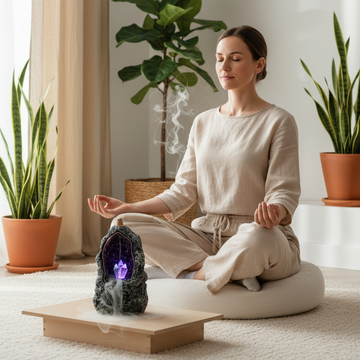
Introduction: Why a meditation corner setup can make calm feel automatic
You don’t need a silent cabin in the woods to feel grounded. Most of us are trying to reduce stress in the middle of real life—dishes in the sink, messages buzzing, a living room that’s also an office, gym, and family hub. If meditation feels like “one more thing,” it’s not because you’re doing it wrong. It’s because your environment isn’t helping you.
A meditation corner setup is a small, intentional nook that gently trains your brain: this spot means exhale. Over time, your living room becomes a cue for calm—not a cue for scrolling, multitasking, or bracing for the next demand. This is the heart of sustainable mindfulness practice: making the right thing easier, not harder.
In this guide, I’ll walk you through how to create a tiny meditation nook that supports anxiety relief, steadier energy, and even better sleep—without needing to redecorate your home or buy a cart of aesthetic objects.
The Science/Why: How a calming room setup retrains your nervous system
Your body is constantly scanning for safety or threat. That’s not personal weakness; it’s biology. When your brain perceives “too much,” it activates the stress response—a cascade involving adrenaline and cortisol designed to help you act fast. Helpful in an emergency, exhausting in daily life.
A consistent meditation space at home works through a few simple mechanisms:
- Classical conditioning: When you practice in the same place repeatedly, your brain begins to associate that visual cue (the corner, cushion, candle, plant) with settling. You start to relax faster because you’ve rehearsed relaxation there.
- Nervous system patterning: Repeated cues of safety (soft light, stable seat, minimal clutter) support parasympathetic activation—your “rest-and-digest” mode. This is why a tiny corner can feel like a switch.
- Cognitive load reduction: Decision fatigue is real. A pre-made nook reduces friction: you don’t have to hunt for a pillow, clear space, or wonder what to do. That makes consistency more likely.
- Interoceptive awareness: Practices like breathwork techniques and a body scan strengthen your ability to notice internal signals earlier—tight jaw, shallow breathing, racing thoughts—so you can regulate before you spiral.
The mental health benefits of a steady routine are often less about a single “perfect” session and more about repeated, doable moments of downshifting. Your living room can become a gentle training ground for that skill.
The How-To (Deep Dive): Build a meditation corner setup that becomes a cue for calm
Below are practical steps that work even if you’re in a small apartment, share space with family, or don’t want your home to look like a wellness showroom. Think of this as simple environmental design for your mindfulness routine at home.
Step 1: Choose a “low-traffic, low-decision” corner (even if it’s tiny)
The best meditation nook isn’t the most beautiful—it’s the one you’ll actually use. Look for a spot with fewer interruptions and fewer temptations to multitask.
- Pick a corner where you can face a wall, window, or plant—something visually quiet.
- Avoid sitting directly in line with the TV, a messy desk, or a charging station if possible.
- If you share space, choose a corner that can be “yours” for 10 minutes—early morning, lunch break, or before bed.
One underrated home sanctuary idea: make it a “no-phone zone.” Not as punishment—just as a kindness to your attention.
Step 2: Prioritize posture and comfort so your body can stop negotiating
If your knees hurt, your back collapses, or your shoulders creep upward, your nervous system stays subtly guarded. A stable, supportive meditation posture signals safety. The goal is a comfortable seat that feels steady—not rigid.
Try this quick posture checklist:
- Hips slightly higher than knees (helps your spine stack naturally).
- Neutral pelvis (not tucked, not overly arched).
- Spine tall, chest soft (think “lifted, not stiff”).
- Jaw unclenched and tongue relaxed.
Support makes this dramatically easier. If you like floor sitting, an ergonomic cushion helps your hips elevate and your spine align. A supportive option for many bodies is the ergonomic meditation cushion, especially if you want steadiness without forcing your knees into deep flexion.
If you prefer a different feel—slightly different height and resilience—a second option is the supportive meditation cushion, which can be helpful if you’re aiming for a balanced seat that stays buoyant over time.
Comfort isn’t a luxury here—it’s part of the regulation strategy. When your body stops fidgeting, your mind has a chance to settle.
Step 3: Add one “sensory anchor” to create a calming room setup
Calm is sensory. You don’t have to overhaul your decor, but one or two consistent cues can shift your state quickly.
- Light: Choose softer lighting (lamp, warm bulb). Bright overheads can feel activating at night.
- Scent: A single essential oil, incense, or even fresh air from a window can become a ritual cue.
- Sound: Gentle ambient sound, white noise, or silence—whatever helps your system feel safe.
- Texture: A soft throw, simple mat, or rug under your feet can signal “settle.”
This is not about perfection. It’s about repetition. The same cue, in the same spot, paired with the same downshift practices, becomes a shortcut for your nervous system.
Step 4: Install a 10-minute ritual: breathwork + body scan (no pressure to “clear your mind”)
If you want your nook to train your brain, give it a reliable routine. A short, repeatable sequence works better than occasional long sessions. This is where consistency wins.
Here’s a simple 10-minute structure that supports anxiety relief and can set you up for better sleep if practiced in the evening:
- Minute 1: Arrive. Sit down. Feel the contact points: feet, legs, seat, hands.
- Minutes 2–4 (Breathwork techniques): Inhale through the nose for 4, exhale for 6. Keep it gentle. Longer exhale = stronger “safety” signal.
- Minutes 5–8 (Body scan): Move attention slowly from forehead to jaw to throat to chest to belly to hips to legs. Notice sensations without fixing them.
- Minutes 9–10: Let awareness be open. If thoughts come, label softly: “thinking,” then return to sensation.
If you prefer structure, a guided meditation can be perfect here—especially on days when your mind is loud. Use guidance as a stabilizer, not as a crutch. Over time you may alternate between guided and unguided depending on your bandwidth.
Grounded reframe: Meditation isn’t about never thinking. It’s about noticing you’re thinking and coming back—kindly, repeatedly. That return is the training.
Step 5: Tie it to an existing daily routine so it becomes automatic
The easiest way to build a mindfulness routine at home is to “attach” it to something you already do. Your meditation corner setup becomes the bridge between habit and calm.
- Morning anchor: After brushing your teeth, sit for 5–10 minutes.
- Workday reset: Before opening your laptop, do 3 minutes of breathwork.
- Evening wind-down: After washing dishes, do a body scan to transition toward sleep.
Start small enough that your brain doesn’t argue. Five minutes done consistently reshapes your stress baseline more reliably than 30 minutes once a week.
Tool Kit: Cushions, props, and simple setup essentials for a meditation space at home
You don’t need much, but the right props reduce discomfort and help your body trust the process. Consider this your practical toolkit for a meditation space at home that supports real-life bodies.
- Meditation cushion: Supports hips and spine for an easier upright posture.
- Zabuton or folded blanket: Cushions ankles and knees; adds warmth and definition to your space.
- Yoga block or firm pillow: Great under knees in a butterfly seat, or under hands for shoulder release.
- Wall support: Sitting with your back near a wall can reduce strain and increase safety when you’re tired.
- Timer or gentle bell: So you’re not checking a phone.
If you’ve heard of a zafu and zabuton set, that’s essentially the classic pairing: a supportive seat (zafu-style cushion) plus a padded base (zabuton) that protects knees/ankles. Even if you don’t buy a full set, you can recreate the function with a cushion + folded blanket.
One more tip: keep your props visible. When they’re tucked away in a closet, your brain has to “start from zero.” When they’re already there, your space becomes a quiet invitation.
Common Obstacles (FAQ Style): Common questions about creating home sanctuary ideas that stick
“My living room is busy. Can I still do a meditation corner setup?”
Yes. A meditation corner doesn’t have to be a whole room. It can be a single square meter—just enough to sit and breathe. If your space is shared, focus on repeatable cues rather than total silence.
- Use a foldable mat or small rug that comes out only for practice.
- Choose one object (lamp, plant, cushion) that marks the space.
- Practice at a predictable time so others learn the rhythm.
It’s okay if life happens around you. Part of mindfulness practice is learning to steady yourself even when conditions aren’t perfect.
“I can’t sit comfortably on the floor—does that mean meditation isn’t for me?”
Not at all. Meditation is not a flexibility contest. The purpose is nervous system regulation and attention training, and you can do that sitting on a chair, couch, or bed (with a few adjustments).
- On a chair: place feet flat, sit forward of the backrest, lengthen your spine.
- On the floor: elevate hips with a cushion; support knees with blankets.
- If you’re dealing with pain: shorter sessions plus more support is the wise route.
A comfortable seat helps your system feel safe enough to soften. If discomfort dominates, the stress response stays online and you’ll end up “white-knuckling” your way through. Support is not cheating—it’s skillful.
“My mind races. How do I get anxiety relief if I can’t stop thinking?”
Racing thoughts are a common stress symptom, not a meditation failure. When cortisol is elevated, your brain is scanning for problems to solve. The practice isn’t to force silence; it’s to change your relationship with thoughts.
- Start with breathwork techniques (like longer exhales) to downshift physiology first.
- Use a guided meditation when the mind feels too loud to hold alone.
- Try a body scan to move attention from the “story” back into sensation.
With repetition, the space becomes a cue: “We don’t have to solve everything right now.” That’s where the deeper mental health benefits show up—more choice, more steadiness, less reactivity.
Comparison: Chair vs. cushion, morning vs. night, guided meditation vs. silent practice
Different approaches work for different bodies and seasons of life. Here’s a grounded comparison so you can choose what supports consistency rather than what looks ideal.
- Chair vs. Cushion: A chair is great if your hips/knees are sensitive or you’re at work. A cushion can feel more “ritual-like” and helps many people find a stable meditation posture. The best choice is the one that keeps you comfortable enough to stay present.
- Morning vs. Night: Morning practice can set your stress baseline for the day and help you reduce stress before it accumulates. Night practice supports unwinding, and a body scan can be especially supportive for better sleep. If you can, try 5 minutes in the morning and 5 at night—tiny bookends.
- Guided meditation vs. Silent: Guided sessions provide structure and are often easier when anxiety is high. Silent practice builds self-reliance and deeper listening. Many people alternate: guided on busy days, silent on calmer days.
The point isn’t to pick the “best” method. The point is to create a calming room setup that makes showing up feel natural.
Conclusion: Your meditation space at home is a gentle agreement with yourself
A meditation corner setup isn’t about having a perfect home. It’s a small, steady signal to your nervous system: you can land here. Over time, that signal gets stronger. Your breath settles quicker. Your shoulders drop sooner. Your stress response becomes less hair-trigger, and you build real capacity for anxiety relief, emotional balance, and better sleep.
If you take only one step today, make it this: choose a corner and place your cushion or seat there—visible, ready, uncomplicated. Then commit to five minutes for seven days. That’s enough to begin training your brain toward calm.
Your living room can still be a living room—messy, shared, real. And it can also become a cue for calm. You don’t have to escape your life to find peace inside it.