
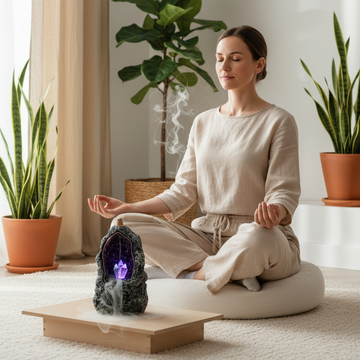

A 10-minute wind-down you can do in bed (without over-efforting)
If your mind gets loud the moment the lights go out, you are not alone.
This 10-minute meditation before sleep routine is a simple way to settle in without trying to force sleep.
The key is to keep it small, repeatable, and gentle: no perfect posture, no special breathing patterns, and no pressure to feel anything in particular. Think of it as creating a soft landing for your attention after a day of problem-solving, scrolling, and decision-making. When you practice in a low-effort way, you give your nervous system a chance to downshift on its own time.
Below is a practical in-bed routine you can follow as written, then adjust to fit your body and your bedroom. It is designed for nighttime overthinkers: people who do well with a clear sequence, but do not want a long session or a complicated method.
Before you start: set up a low-friction space
You can meditate lying down, but a small angle for your upper body often helps you stay present without having to brace your neck. If you have a cushion you already love, use it. If you want a supportive prop that is easy to bring to bed, consider something compact that holds its shape and does not collapse as you relax.
If you sit up in bed to begin, a supportive cushion can reduce the urge to fidget. You can try a t-shaped ergonomic meditation cushion behind your lower back or under one hip to find a steadier position.
Also, make the environment friendlier to calm attention: dim the room, silence nonessential notifications, and keep the temperature comfortable. If you like sound, choose something consistent and non-demanding (for example, a steady fan) rather than anything that pulls your attention into lyrics or story.
The 10-minute in-bed sequence
Use a timer if that helps your mind stop clock-checking. If a timer creates pressure, skip it and just move through the steps at an unhurried pace. The point is not to do it perfectly; it is to do it kindly.
- Minute 0-1: Arrive. Let your eyes soften or close. Feel where your body touches the mattress and blankets.
- Minute 1-3: Let the breath be natural. Notice one full inhale and one full exhale, then do that again. If you lose count, simply start back at one.
- Minute 3-6: Scan for obvious tension. Check forehead, jaw, shoulders, belly, and hands. Where you find tightness, see if you can allow 5% more ease.
- Minute 6-8: Name what is here. Silently label: thinking, planning, remembering, worrying, or listening. Then come back to the next exhale.
- Minute 8-10: Choose a closing cue. For example: soften the face, feel the pillow, and take one slower exhale. Then stop trying and let rest be rest.
That is it. Notice how small the routine is on purpose. Many overthinkers improve consistency when the practice feels almost too easy, because the mind cannot argue with a short, gentle commitment.
What to do when thoughts keep racing
When your brain insists on solving tomorrow tonight, the goal is not to win a debate with your thoughts. Instead, practice changing your relationship to them. Thoughts can be present without being followed.
Try this: when a thought arrives, silently say planning or replaying. Then place your attention on a concrete sensation for one breath cycle: the rise of the chest, the touch of fabric at the shoulder, or the warmth at the hands. If you get pulled back into the story, you did not fail; you noticed, which is the practice.
If you are carrying a lot mentally, a tiny external container can help. Keep a notepad beside the bed and do a 60-second brain-dump earlier in the evening, not during the meditation. That way, you are not training your mind to associate the wind-down with problem-list building.
How to make it feel comfortable (not like homework)
Over-effort often shows up as: forcing deep breaths, holding a rigid posture, or scanning the body like you are searching for a problem to fix. Comfort comes from permission. Give yourself permission to be human and a little restless.
Small adjustments can help you stay with the practice without turning it into a project:
- If you lie flat and get sleepy immediately, begin propped up for the first few minutes, then recline for the last two.
- If your neck feels cranky, add a thin pillow or fold a towel to reduce strain.
- If your hips or lower back feel unsettled, place a cushion under the knees when lying down, or behind the low back when sitting.
- If your shoulders creep up, exhale and let the weight of the arms sink into the blanket.
For a stable sit at the start of the routine, some people like a firmer cushion that holds their posture without making them tense. An option like the Unity meditation cushion with resilient support can be used on the bed or floor depending on your space and what feels easiest that night.
A simple mindset that keeps this sustainable
If you are a nighttime overthinker, you may be used to measuring progress by outcomes: Did I fall asleep fast? Did I wake up? Did I do it right? A calmer approach is to measure by inputs: Did I show up for 10 minutes? Did I return to sensation when I noticed I was lost in thought?
Some nights will feel smooth. Some nights will feel busy. Both can be part of the same routine. When your practice is about showing up rather than achieving a specific state, it becomes easier to continue even when life is stressful.
How to weave it into your actual bedtime (even on messy days)
Consistency is less about willpower and more about removing friction. If you wait until you are exhausted and already scrolling, starting can feel impossible. Instead, link the routine to an existing cue.
Choose one cue you already do most nights, then attach the wind-down to it. For example: after brushing teeth, after putting your phone on the charger, or right after you turn off the main light. Keep the sequence the same so your brain learns what comes next.
- Pick a cue: charger, teeth, lights.
- Set the bed: pillow and blanket, then one supportive prop if you use one.
- Start the 10 minutes before you decide whether you are sleepy.
If you miss a night, avoid the all-or-nothing trap. The next night, do the smallest version: two minutes of noticing your exhale and relaxing the jaw. Small counts, especially when you are rebuilding trust with your own routine.
Common obstacles and gentle workarounds
If you notice certain patterns, try these low-pressure tweaks:
If you keep checking the time: hide the clock face or place your phone face down across the room. If you wake in the night: repeat only the first three minutes of the sequence, then stop efforting again. If you feel impatient: shorten the labels to just thinking and return to one physical sensation.
If you worry you are doing it wrong, remember that meditation is not a performance. You are simply practicing coming back. That skill often carries into the moment you decide to put down the day and let the night be the night.
Closing: make it yours
Your best routine is the one you will actually use. Keep it simple, repeat it often, and let it evolve. Over time, this kind of gentle wind-down can become a familiar signal: nothing to solve right now, nothing to prove, just a few minutes of attention and a softer landing into rest.