
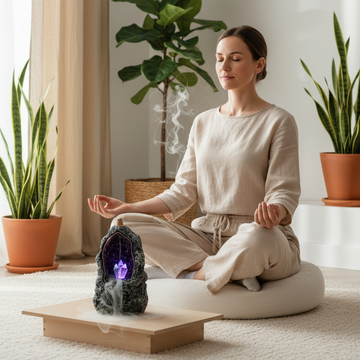

A gentle fake nap for nights when your mind will not shut off
If you are a nighttime overthinker, you probably know the feeling: you are tired, but your brain keeps writing tomorrow's to-do list, replaying conversations, or scanning for what might go wrong. The goal here is not to force sleep, but to give your nervous system a clear signal that the day is over.
A fake nap is a short, low-pressure rest where you lie down and practice letting the body settle without trying to fall asleep.
Why this helps when you are stuck in thinking mode
When your mind is loud, effort often backfires. Trying hard to sleep can create a loop of checking: Am I asleep yet? Why am I still awake? A fake nap shifts the target from sleep to rest, which is usually easier to access.
It also gives you something simple to do that is not scrolling, not problem-solving, and not bargaining with the clock. Over time, this can become a familiar cue that tells your system: nothing to fix right now.
Set up: make the bed feel like a landing pad (not a battleground)
Keep your setup boring and repeatable. The less you decide at night, the better. If possible, dim the room and reduce bright, overhead light. If you like scent, keep it subtle and consistent, not stimulating.
Support matters too. If your hips or low back get fussy, you may find it easier to rest when your knees are slightly elevated or your torso is gently propped. Some people like a small cushion under the knees; others prefer a wedge-like lift behind the upper back.
If you read or journal before bed and want a supportive seat that does not strain your hips, a floor cushion can help your wind-down stay comfortable and unhurried. The t-shaped ergonomic meditation cushion is designed to support a stable seated posture, which can make your pre-bed routine feel less like endurance and more like a gentle transition.
The fake nap practice (10 to 15 minutes)
Pick a short window so your mind does not panic about committing to a whole night of doing it wrong. If you want, set a soft timer with a quiet sound. If timers feel activating, skip it and just do a few rounds of the steps below.
1) Give your body a clear start signal
Lie down and place both feet on the bed with knees bent, or extend your legs long, whichever feels more settling. Let your arms rest by your sides or one hand on the belly and one on the chest. Take one slow exhale and mentally note: Rest now.
2) Unclench the effort
Notice where you are trying: forehead, jaw, tongue, shoulders, belly. Pick one spot and soften it by 5 percent. You are not chasing perfect relaxation. You are practicing the skill of letting go in small increments.
3) Use a simple anchor that does not require performance
Choose one neutral sensation: the weight of your body on the mattress, the touch of the blanket, or the feeling of air at the nostrils. Keep it gentle, like you are listening from another room.
If your mind keeps pulling you into stories, try this: name what is happening in two words, then return to sensation. Examples: Planning, remembering, judging, worrying, rehearsing. No debate, no analysis.
4) Let thoughts pass without escorting them out
Thoughts are allowed. Your job is not to stop them; your job is to stop following them. When you notice you are in a mental conversation, quietly return to the anchor. That return is the practice.
5) Close with a smooth transition
At the end, do not pop up. Take one longer exhale. Then choose one of two options: roll to your side and stay in bed, or get up calmly for a brief reset (more on that below). Either choice can be wise depending on how activated you feel.
Evening wind-down steps you can repeat every night
Consistency is often more calming than novelty. Here is a simple checklist you can adjust to your life and still keep the same overall shape.
- Pick a lights-down time that is realistic most nights.
- Do one small closure action: set out clothes, plug in devices, or write a 3-item tomorrow list.
- Lower stimulation for 20 minutes: softer lighting, quieter audio, no urgent conversations.
- Do the 10 to 15 minute fake nap practice in bed.
- If still wide awake, do a calm reset outside the bed for 10 minutes, then return and repeat.
What to do if your brain says: this is not working
That thought is common, especially for people with racing thoughts at night. Try reframing success: if you rested your body for 10 minutes and practiced not chasing thoughts, you did the practice. Sleep is welcome, but it is not the only measure of a good night routine.
Here are a few gentle adjustments:
If you feel trapped in bed, switch to a side-lying position or place a pillow between your knees for comfort.
If you keep checking the clock, turn it away or move it out of reach.
If your mind wants to solve problems, keep a notebook nearby and write a short list titled: Not tonight.
If silence feels too loud, try a steady, low-volume sound like a fan or white noise.
Seated version for people who get restless lying down
Some nighttime overthinkers feel more settled when they start upright, then lie down after their system softens. If that is you, do a short seated practice first: sit comfortably, feel your sit bones supported, and take five slow exhales. Then transition to bed for the fake nap.
A supportive seat can make this easier to repeat because you are not battling numb legs or a strained back. The Unity meditation cushion is an option for an evening sit that feels steady without feeling rigid, especially if you like a little lift under the hips.
How long until this feels natural
Think of this as training the off switch, not perfecting a technique. On some nights, the fake nap may glide into sleep. On other nights, it may simply reduce intensity by a notch. Both outcomes are useful.
If you keep the same basic sequence, your brain may begin to associate it with safety and shutdown. The key is repeating it with a kind attitude, even when it is messy.
A simple script you can borrow
If your mind needs words to hold onto, try this quiet internal script:
Body resting. Breath moving. Thoughts allowed. Nothing to solve. Return to weight. Return to warmth. Rest is enough.
Over time, this can become your bedtime meditation routine, a familiar container for nights when sleep is shy and your mind is busy.
When to get up for a brief reset (and how to do it gently)
If you feel increasingly frustrated, sweaty, or mentally sped up, it may help to step out of bed briefly. Keep it low-stimulation: dim light, no phone, no news, no work. Try one of these for 10 minutes: a warm drink without caffeine, light stretching, or reading something calm. Then return to bed and repeat the fake nap steps.
The aim is to protect your bed as a place for rest, not a place for arguments with your thoughts. With repetition, many people find the whole process becomes quieter and more automatic.