
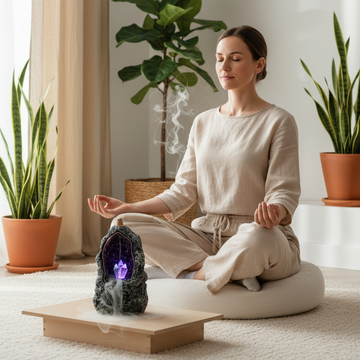

A 12-minute wind-down that stays awake, soft, and doable
If you are a nighttime overthinker, you do not need a perfect ritual to feel more settled. A 12-minute wind-down can help you close the day without drifting into a nap.
This bedtime routine meditation is designed to feel like a gentle off-ramp from thinking, not another task to ace.
Set up so you stay comfortably alert (without getting wired)
The sweet spot is cozy enough to relax, but structured enough to keep you from melting all the way into sleep. A few small choices make a big difference, especially if you tend to start strong and then doze off.
- Choose a dim, warm light (not bright overhead) and lower the room temperature a touch if you can.
- Sit slightly upright with your hips a little higher than your knees. This encourages ease without slumping.
- Use a timer for 12 minutes so you are not checking the clock.
- Keep your gaze soft and low, or close your eyes if that feels safe and comfortable.
- If you are in bed, consider propping your back and keeping both feet grounded or knees supported so you do not fully sprawl.
If sitting is uncomfortable, support matters more than willpower. Many beginners find that a stable base reduces fidgeting and keeps the breath steady. A cushion that helps you tilt the pelvis slightly forward can make it easier to relax your belly and lengthen your spine.
If you want a supportive seat for nightly practice, try a T-shaped ergonomic meditation cushion for grounded hips and adjustable feel.
The 12-minute structure (so you do not have to improvise)
Overthinking often shows up when the mind senses open space. A simple structure gives your attention something kind and specific to do.
- Minute 0 to 2: Arrive and choose one intention.
- Minute 2 to 6: Gentle breath counting to settle momentum.
- Minute 6 to 10: A light body scan that stays awake.
- Minute 10 to 12: Close the day with a short script and transition.
Read the script once in the daytime if you like, then use it from memory at night. The goal is not to be word-perfect. The goal is to guide your attention back to something simple, again and again, without judgment.
Minute 0 to 2: Arrive (no pressure, no performance)
Sit down and let your hands rest. Feel the contact points: feet, legs, seat, and whatever supports you. Let your shoulders drop one millimeter. Unclench your jaw if you notice it working.
Pick one intention that is gentle and realistic, such as: I am allowed to slow down, or I am practicing letting today be complete. Keep it small. You are not trying to solve your life in 12 minutes.
Minute 2 to 6: Breath counting for overthinkers
This part is intentionally mild. Strong breathwork can feel too stimulating at night, so keep it easy.
Inhale normally. Exhale normally. On each exhale, count silently from one to ten, then start again at one. If you lose the count, simply return to one on the next exhale. The moment you notice you wandered is the moment you are back.
If counting feels rigid, switch to labeling: inhale, exhale. Or rest your attention at the sensation of air at the nostrils. Choose the simplest option that keeps you present.
Minute 6 to 10: A gentle body scan that does not become a nap
The trick is to scan with curiosity rather than sinking. Keep the spine tall, and imagine you are softly turning on lights in each area rather than trying to relax everything at once.
- Forehead: smooth without forcing.
- Eyes: let them rest heavy.
- Jaw and tongue: loosen slightly.
- Throat and chest: notice the breath moving.
- Shoulders: drop and widen.
- Hands: feel warmth or tingling.
- Belly: allow it to be soft.
- Hips and seat: feel steadiness and support.
- Legs and feet: sense weight and contact with the floor or bed.
If you start to drift, do not scold yourself. Lightly deepen the next inhale, sit a fraction taller, and open your eyes for two breaths. Then continue.
Support under the hips can help you stay upright with less effort. If you prefer a broader seat for stability, the Unity meditation cushion with resilient support can make it easier to maintain a relaxed, wakeful posture.
Minute 10 to 12: Close-the-day script (gentle, not dramatic)
Use this as a quiet mental read-through. Move slowly, leaving a breath between lines. If a line does not fit, skip it.
Today is done. I do not need to carry it through the night.
I acknowledge what mattered today, even if it was small.
I release what I cannot fix right now. It can wait for daylight.
If my mind brings up unfinished thoughts, I can note them and return to the breath.
I choose one word for how I want to meet tomorrow: steady, kind, clear, or simple.
For the next few minutes, I will rest without solving anything.
Now take three easy breaths. On the last exhale, imagine placing the day on a shelf. Not thrown away. Just set down.
How to avoid the common bedtime meditation traps
If you have tried meditating at night and it either turns into a nap or turns into a thinking marathon, you are not alone. Here are practical tweaks that keep the routine beginner-friendly.
- If you keep nodding off: sit up more, keep a cooler room, open your eyes for a few breaths, and shorten the body scan.
- If your mind speeds up: reduce effort, soften your breath, and return to counting on exhale only.
- If you feel restless: add a simple anchor like feeling your feet or noticing contact points, not chasing perfect calm.
- If you get frustrated: switch to a kindness phrase like may I be at ease, and let that be enough.
You can also keep a small notepad nearby and write one line before you start: tomorrow list. This is not journaling. It is a quick brain-dump so your mind does not have to rehearse it in circles.
Make it a routine without adding pressure
The easiest routine is the one you can repeat. Aim for most nights, not every night. If you miss a day, nothing is ruined. Start again the next evening.
Try pairing the 12 minutes with a simple cue: brushing teeth, dimming lights, or setting your phone to charge outside the bedroom. Consistency comes from making the start automatic.
Finally, end with a clear transition. When the timer finishes, do not jump straight into scrolling. Stand up slowly, take a sip of water, and move into sleep the same way you entered practice: gently.